
When should a tree be trimmed instead of removed?
A lot of trees people think have to come down only need the right cuts. Trimming is the answer when the tree itself is healthy but part of it is a problem:
- Dead limbs over the house. Dead wood gets brittle and drops without warning, often in the first wind or snow of winter. D. M. had “some large, dead, over the house branches that were going to be a problem in the near future.” The crew took them off before they became that problem.
- Branches on the roof or in the gutters. Limbs that rub the roof wear it down, and needles and leaves pile up in the gutters.
- Low limbs near the ground. Raising the crown gives you room to walk and drive under the tree, and on Cobb Mountain it keeps a ground fire from climbing into the canopy. That is a big part of defensible space work.
- A crown that is too thick. Thinning lets light and wind through, so the tree catches less wind in a storm.
- An insurance notice. Insurance companies in fire country are asking more owners to clear branches off and away from the house.
If the trunk is cracked, the tree is dead, or most of it leans over the house, trimming will not fix it. Then removal is the honest answer, and Robert will say so.
How we trim without hurting the tree
Good trimming is about where you cut, not how much. A good cut goes back to a healthy branch or to the collar where a limb meets the trunk, so the tree can seal the wound. Topping a tree or stripping it down to a pole leaves it weak. A tree that is pruned well should look like itself afterward, just lighter and cleaner.
Some customers want to get it exactly right. Barbara E. wrote that R2 “researched trimming with nursery to get it just right.” That is how we like to work: if a tree or a plant needs special care, we find out what it needs before we cut.
Robert’s way of thinking about trees runs through the trimming too: “When we touch trees, when we plant trees, even when we bring trees down, the whole process is conscientious.” A tree that stays should stay healthy.
Why the spider lift matters for trimming
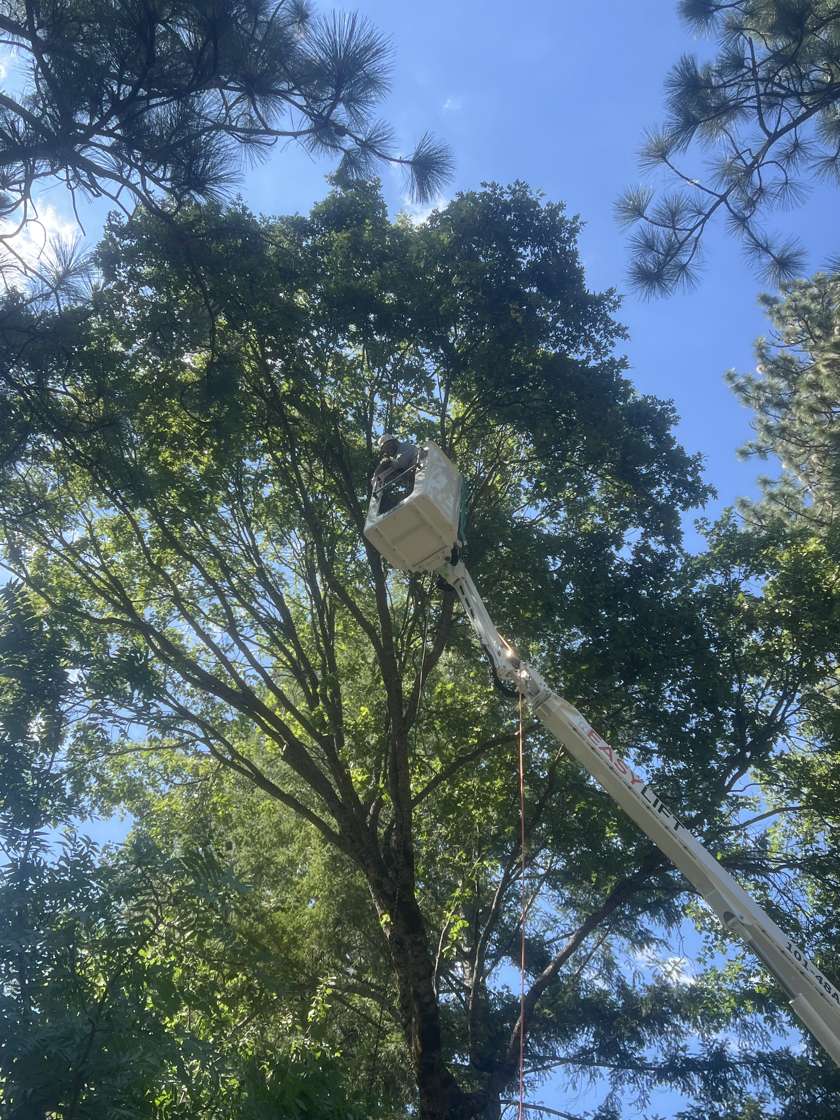
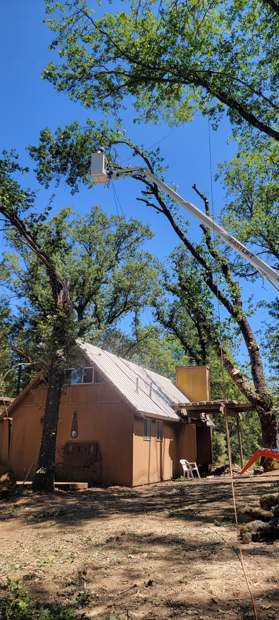
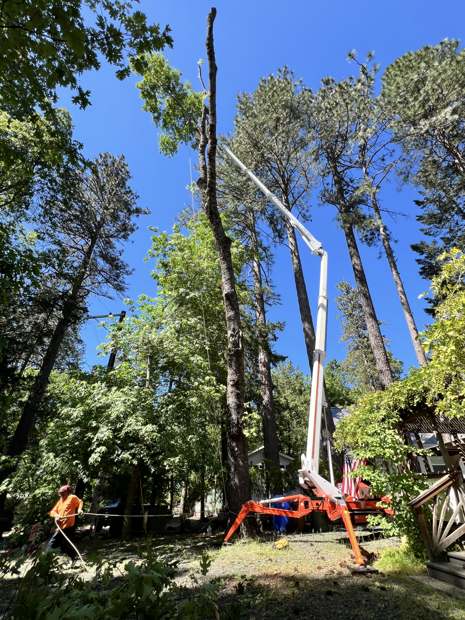
A lot of yards on Cobb Mountain and around Clear Lake are tight: cabins on slopes, decks under big oaks, gates a truck will not fit through. R2’s tracked spider lift walks in on its own tracks, sets its legs down on a lawn, a patio or a driveway, and puts a person up in the canopy. In the words of the old R2 site, it lets us “access tight spaces and hard to reach areas.”
From the basket the trimmer can reach the end of a long limb over a roof and take it off in small pieces, lowering each one, instead of dropping a whole branch onto the shingles. Where the lift cannot go, the crew climbs. John V. noticed the range: “They did it all from cleaning the gutters to climbing trees to cut branches.”

What moves the price of tree trimming?
We price trimming after we see the trees, and you get the number before we start. What makes it more or less:
- How many trees and how big. One oak over the deck is a short job. A row of tall pines is a day or more.
- What is under the limbs. Over a roof or a power line, the wood comes down in small pieces. Over open ground it can drop.
- Access. Whether the lift can reach the tree or a climber has to go up.
- How much dead wood. Dead limbs take care to remove safely.
- Cleanup. Chipping the brush, hauling it, or leaving firewood.
Customers describe the pricing in their own words: “Price was acceptable,” “their pricing was very reasonable,” and “great job at a reasonable price.”
When there is a deadline
Sometimes the trimming has a due date. Paula C. wrote about her dad, who was told by his insurance company to get overhanging branches off his rental home “in 3weeks time or his insurance company was saying they would cancel his policy.” He had a hard time finding someone that fast. “When he called this company, R2 they responded and did the job within 2 days of calling them.”
We cannot promise every job that fast, but if you have an insurance letter or an inspection coming, tell us the date when you call or text and we will tell you honestly what we can do.
What happens to the branches
Brush from a trim goes through our chipper. The chips become wood mulch, which can go right back under your trees if you want it, or back onto the land. Bigger limbs can be cut as firewood. Very little of what we trim goes to waste, which is the way Robert has run R2 since the start.
